The Cambridge Audio Melomania M100 Wireless Headphones can capture the essence of great fidelity at an extraordinary PRICE!
I always try to keep an open mind about any technology or way to listen to music, and I only forget about the technology if it does not live up to my stringent measures of realism and fidelity. In my mind, speakers, headphones, and IEMs all have qualities I enjoy and give me a different perspective on the music that intrigues me.
For years, what is now IEMs were called earbuds, and they were predominantly used for convenience or when an actual headphone would be too large or not work due to active movement. I would take earbuds to the gym or on walks, knowing that the sound quality would almost certainly be abysmal but would be easy to use and work better for that activity. I would suffer through the limited sound quality, wishing something could be done about the sound quality. Then something happened!
The headphone movement started in the mid-2000s, and companies worldwide began to see the viability of headphone audio and its cost and convenience advantages over two-channel audio. Many people today do not have large homes or apartments to fit a high-end two-channel system. When they think about the high costs of two-channel gear today, many people see headphone audio to get ultimate fidelity at a fraction of the price of two-channel gear.
I completely understand their stance on this, as I have worried about our industry when I see million-dollar speakers and half-million-dollar amplifiers on the market. Sustainability, the high-end audio world is not going to come from these billionaire-only products! But from making products that the average person can work to afford.
Headphone audio provides a path to audio excellence at prices that are just not attainable in two-channel audio and is one of the reasons why I am glad that The Sound Advocate (to be reviewed very soon) is taking on reviewing headphone audio as part of our regular content.
True Wireless IEMs are a unique product; I have had good and bad experiences with them. Many of these feature-rich products do many cool things beyond serving up your favorite music, but it seems the sound quality is left on the table for many. Most have tunings that favor low bass, an overly warm midrange, and treble energy that is too harsh or lacks detail. With all the build budget going to features and connectivity instead of the driver or amplifiers/DAC circuits in these products, it is not hard to see why they fail in the sound department.
Cambridge Audio is a British company that has designed and built high-end but affordable products for almost 50 years. In the late ’60s, they were the first to put a toroidal transformer in a power amplifier, which nearly all high-end audio companies now incorporate in their products. They have lived by the philosophy of making high-quality, great-sounding products that almost everyone can afford and enjoy. And it is in this philosophy that the Melomania M100 was born.
According to Cambridge Audio, unlike many of the truly wireless in-earphones on the market, the M100 is an actual sound-first design. First and foremost, they wanted the M100 to get the sound right and then work on the features and technologies. This approach is also shared by brands like Sennheiser, Technics, and Denon, which make their true wireless IEMs. It seems to be the theme with true wireless IEMs that the colossal budget companies like Sony, Bose, and Apple design better features like noise canceling, Spatial Audio or Dolby Atmos integration, and touch control. They have the budgets, facilities, and manpower to test and perfect these systems to perform flawlessly; although they may go to cheaper methods as to the driver sound quality at hand.
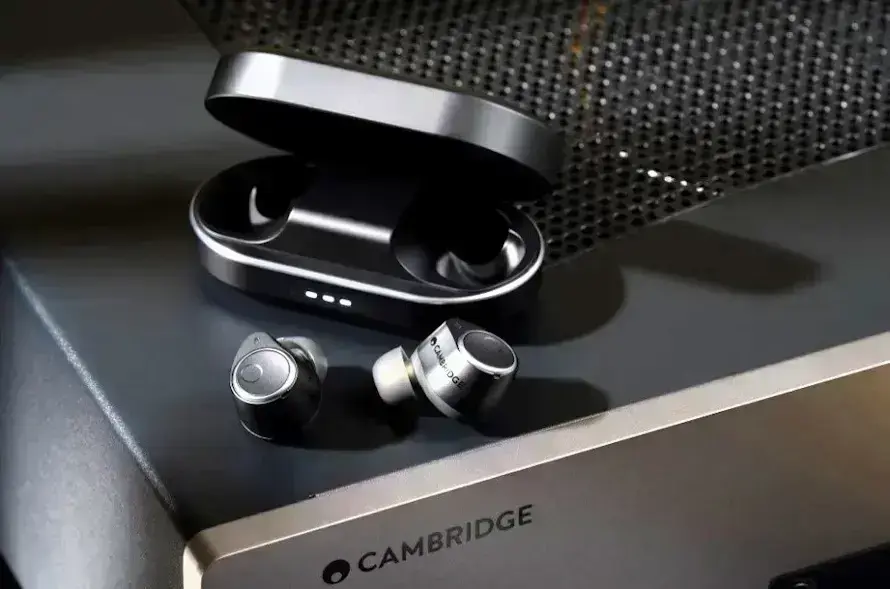
Cambridge Audio decided to do something different than everyone else on the market and use class A/B amplifiers in the M100 True Wireless headphones. Using their class A/B amplifiers in the M100 fixes one of the issues with these products. Most True Wireless Headphones are designed to use the amplification circuits added with most off-the-shelf Bluetooth DAC chips. These chips have the Bluetooth receiver, DAC, and amplifier built into one chip. This offers an economical solution to companies building these headphones but shortchanges the amplification sections to reduce costs or for convenience. Cambridge chooses to separate the amplification section and use their design, which promises superior imaging, soundstaging, and tonal performance compared to the integrated chip amps.
The M100s’s driver is a 10mm custom-made driver with recycled Neodymium magnets. Cambridge then tunes this driver in its enclosure for the best combination of bass quality and detail, midrange detail and tone, and treble detail while remaining smooth.
They decided to go with a Qualcomm QCC3071 tri-core architecture chipset to utilize the full benefit of Bluetooth 5.3’s technology. This relentless processing unit utilizes the Bluetooth signals from the aptX™ Lossless, aptX™ Adaptive, AAC, and SBC codecs for which it is compatible.
This powerful chipset also has a 3-microphone Qualcomm® cVc™ Echo Cancelling and Noise Suppression (ECNS) system for making phone calls or meetings when a microphone is needed. It ensures that voice transmissions are clean and without outside distortions. The Qualcomm™ Adaptive Active Noise Cancelling system is built right into this chipset for the noise-canceling technology. I like that Cambridge chose to go with Qualcomm for the tech in the M100; it is a well-known system with a proven track record. Why go through the expense of creating something when companies like Qualcomm have worked on this for years? Let Qualcomm do what they do best and let Cambridge Audio worry about the sound, which is what they do best.
The ANC built into these headphones has three options. Normal mode uses none of the noise-canceling circuits and is just like any passive in-ear monitor. Noise-canceling mode activates the circuits and has three settings low, medium, and high. It will depend on the noise level in your environment and on which one to choose. I tried all three, and every level changed the amount of sound let in.
Now remember, with Qualcomm’s adaptive ANC, the outside noise is monitored, and different levels are automatically chosen depending on the situation. The transparency mode is one I also used a lot, as it takes the same microphones used for noise canceling and uses them to amplify outside noises. This helps in environments where you need to hear certain things, like conversations.
There are also three levels for the transparency mode. A low, high, and voice-focused setting tailors the microphone’s response to the human voice. I used these in my testing, and while they were helpful, I have heard better transparency modes elsewhere. This is something that will hopefully be addressed in an update. Overall, These features worked very well and are only overshadowed by brands like Sony and Bose, which are industry leaders in this technology.

The included smartphone app proved to be an asset with the M100s as it has all of the settings and shows the status of the headphones and the battery life indicators. The app is easy to install and provides all of the settings on one screen.
There are settings for the noise canceling level, a built-in user guide, a mono audio setting to allow mono listening or for when you want to share one of the buds and let both people hear the same audio (this is strange to me, but some younger people get it), a sleep mode that enables you to listen in bed without any of the touch controls active so that you don’t accidentally hit them. There is also a wear-detect mode that can sense when you take both earbuds out and stop the music automatically. And finally, a gaming mode that reduces latency for gaming or when watching movies or shows.
Also included is a feedback hub that allows you to give Cambridge Audio information on how well the headphones work and what needs addressing (I think this is an excellent idea as this allows a direct connection to the company for help). I used the feedback hub a couple of times with issues, and Cambridge always got back to me with helpful hints of things to do to improve the problem. I let them know that I had issues with the left earbud cutting out when I tried the wear detect mode and sleep modes. They advised me to do a factory reset of the headphones, which worked so far.
The M100s have a built-in equalizer with 7-bands of adjustment, and some Cambridge-tuned eq presets. You can also use the EQ to make custom presets to tailor the sound to your ears or preferences. I found this app easy to use and it allowed me complete control of the M100s for whatever situation I used them in.
Touch controls are a staple of the true wireless world and let you control different functions on the M100s without getting your phone out. This is a critical feature for many users, including myself, as I spent a lot of time testing and using it.
The controls are based on touching either the left or right pad on the earbud itself for input. One tap on the right earbud stops or starts the music, a double tap on the right earbud skips forward, and the left earbud goes to the previous track. Volume up is a long press on the right bud, and volume down is a long press on the left bud. Answering and ending calls is a double tap from either side. And your phone’s voice assistant is just three taps on either bud away.
The ear fit is the most important thing to focus on when getting good sound with these products. You will not get good sound if you do not get a tight seal between the bud and your ear canal. Cambridge knows this is important and includes five pairs of tips with the M100s. Small, medium, and large silicone tips and small and large memory foam tips are included. The size and shape of your ears will determine which tip will work best. The large memory foam tip gave me the best deal, which surprised me as the silicone tips generally win for me. However, the large memory foam tips proved to be the most comfortable and best sounding.

Sound and Usability
Having spent a lot of time with the Cambridge Audio Melomania M100, I came away with some very interesting impressions of the sound quality these products can be capable of. Taking the M100s out of the box, I downloaded the Melomania app, paired them with my phone, and was up and running in minutes. I first played a reference track to see how well the M100s were tuned out of the box. I was happy to report that it was mostly a neutral-ish experience besides a heavy-handed bass response.
The bass was easy to tame with the EQ, and I did not need to change any other EQ setting to be satisfied with their response. The drivers in the M100s seem to take EQ very well, as many bass-heavy in-ear headphones seem reluctant to let go of this bass. When you try to adjust the EQ to reduce the boomy bass, this boomy sound seems to take hold and only gets softer with EQ, but the boominess is still there. The M100s are not like this. I adjusted the EQ and noticed that the bass fell right into place with a tight and detailed presentation once adjusted. Once I fixed this issue, the sound became more even-keeled and neutral.
Listening to Birth Of Joy’s 2014 album “Prisoner”, I was served a good helping of bass slam and detail. Once I dialed in the bass on the M100, I was shocked at how even-handed and detailed the bass was. Bass drum hits had good body and tonal accuracy, and bass guitars gave me plenty of string detail and blended great. The midrange was very interesting as it seemed to rise in the mix as frequency increased.
The midrange starts in a v-curve and then rises right before the ear gain area, where most headphones rise in response. I have seen the frequency response curves for the M100, and they back this up. It seems to live in a slight v-curve under about 1kHz, then spring to life with an elevated midrange and treble. This is not drastic and is mostly within the average IEM curve or preference targets, but they allow the M100 to showcase a lively signature while keeping wraps on sibilance and harshness.
The sound was energetic, elegant and impressive for a true wireless IEM at this price. They aren’t breaking new ground here; they are just offering an option with a good driver that takes EQ well. This allows for a balanced sound for folks not interested in shaking their ears off with overdone bass.
The only area that seemed to be lacking was in its dynamics. The music seemed to lack some expression, and when things got lively, dynamics took a back seat. I am unsure if this is the driver’s limitation, the amplification, or something within the Bluetooth receiver or DAC causing this. However, there are some dynamic limitations.
Moving on, I played a few tracks from Steve Miller Band’s 1976 album “Fly Like An Eagle”. I have always loved this album as the studio work is decent but the music takes me back to my childhood! The Cambridge Audio Melomania M100s allowed me to enjoy these tracks fully. Again, after EQ, the bass was tight and responsive, showing a very natural character, allowing bass drums and bass guitar to come alive with detail and natural tone.
Steve Miller’s vocals were clean, clear, and expressive , with no trace of sibilance or harshness. The soundstage and imaging impressed me. They generally will be a hard-panned left, right, or center type of sound, or the soundstage will be so small they almost sound mono. But the M100 gave me a real sense of recorded space. It’s not going to blow you away like a $1,000 wired IEM or something like a ZMF Atrium but for their price and features, it is pretty impressive. You can tell the sound engineers at Cambridge spent some time fine tuning the M100.
These headphones are all-day musical, and they never got fatiguing or out of sorts with any music I played through them. IEMs are meant for portability and travel; If I can get an all-day musical headphone with enough realism, soundstage, and imaging to satisfy even with its somewhat limited dynamics, it is mostly a successful journey to behold!
Just a note about Equalization: I rarely mention equalization for two-channel systems, and there is a reason for that. Suppose your speakers have a relatively flat frequency response anechoically. Then, you put them in your room, and the response gets worse. You need to treat your room first, then work on the positioning of the speakers. With the proper treatments and positioning, equalization is generally not required. If you try to equalize past suitable room treatments or positioning, it will typically cause more problems since the speaker is no longer working within its designed response.
For headphones, it is different. There is no room to treat the room. There is only how they fit on your head or in your ears, how well they seal, and the shape of your ears themselves. All these things can change the frequency response of headphones. Equalization is sometimes required to compensate for this with headphones.
Conclusion
The Cambridge Audio Melomania M100 True Wireless IEMs impressed me. Yes, they are a brand-new product with some growing pains in the usability department. But I believe firmware updates will handle most of those issues.
As far as sound quality goes (which should be the most critical thing when purchasing an audio product), they delivered the goods with exceptional prowess! They do have some stiff competition. Still, Cambridge holds its own in the sound department, delivering a good soundstage, image, and a delectably clear sound without any harshness.
Yes, the dynamics are somewhat limited, but most products in this price class have something they can improve on. The travel case is nice and small, and the battery life is excellent. Charging was easy and fast, and the app always worked even with few exceptions. I had a quick response when I used the feedback hub, and it fixed my problems.
For me, the M100 does live up to being a sound-first design. It is one of the better-sounding true wireless IEMs that I have tested or lived with. I highly recommend anyone looking for an audio travel companion to try to listen to the Cambridge Audio Melomania M100, or at least buy with the option to return. So you can see if its sound was as enjoyable to you as it was to me. Highly Recommended.

Review System: Speakers: Spatial Audio M3 Turbo S open baffle./ REL T9x subwoofer/ Digital: Denafrips Venus II, / Modified PC-based Music server/streamer. PS Audio Airlens Network Streamer Analog: Pro Ject X2 B Turntable, Darlington labs MP-7, and SU-7 phono preamp, Audio Technica AT33 PTG/ii cartridge Amplification: Hegel P20 preamp. Pass Labs X150.5 power amp. Conditioner: PS Audio Quintet. Cables: Iconoclast Series 2 SPTPC speaker cables,IconoclastGeneration 2 ETPC XLR cables and Gotham 4/1 RCA interconnects, Iconoclast BAV REL subwoofer cable
Price: $219.00(On sale as of July 26, 2024 for $159.00)
THE SOUND ADVOCATE
WHERE the MUSIC BEAT meets the AUDIOPHILE ELITE ! SUBSCRIBE BELOW!
Thank you for subscribing.
Something went wrong.