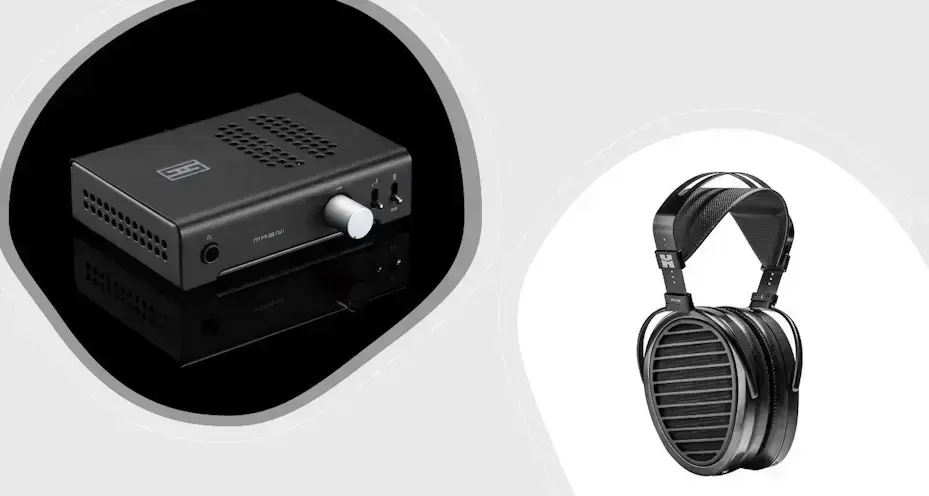
The Schiit Magni Unity and HIFIMAN Arya Stealth at their respective prices have made a lasting impression on Douglas Moore!!
I have been in this hobby for a long time, and I have seen high-end audio undergo a drastic change over this time. Just 10 years ago or so, reference-level products were expensive but not in the way products are now. $750,000 speakers and $180,000 DACs have now entered existence, and with that, an apparent shift in what we think is insane in this hobby.
But there has also been another shift that, in my opinion, is much more important to allow the greater population to enjoy their music the way it should be reproduced. Today, you can get sound quality at great prices if you can overcome your prejudices about affordable gear! Companies like Schiit Audio, JDS Labs, and many others have come on the scene to offer sound quality that was only available at higher prices just a few years ago.
Unfortunately, as the prices keep rising, the snobbery keeps building, and the judgments sometimes get overwhelming. This is sad because high-end audio products costing half a million dollars are not what is going to keep two-channel audio a viable solution going forward!
Headphones themselves have also gone through a change recently. Due to years of ongoing research and development, companies like HIFIMAN, Meze, Audeze, and Abyss are trickling down their best technologies into more affordable options. Meze’s Poet and Abyss’s Joal are just two examples.
HIFIMAN has recently put many of its higher-end offerings on sale at discounted prices, which provides a chance for folks to get into high-end products at mid-fi prices. The products I will be reviewing today fit right into this category. They offer a compelling total package for people wanting excellent sound but needing to stay under a $1K total system price point.
Of course, this is not to say that some great affordable two-channel products from brands like Wharfedale, MoFi, Orchard Audio and many others (some of which I have reviewed here) offer crazy good performance for the money.
In this instance, I proceeded to pair the Schiit Magni Unity and the HIFIMAN Arya Stealth as these two pieces work very well together and make a surprisingly great-sounding system, especially considering the under $1K entry price ($788 to be exact before taxes).


Schiit Audio
Schiit Audio needs no introduction. Founded in 2010 by Jason Stoddard and Mike Moffat, it has been at the center of the headphone amp and DAC world since the headphone movement started. Their concentration was on designing products for the newly invigorated headphone market that would combine their years of experience in making quality audio components, with the drive to make them as affordable as possible (while still paying the bills and designing and building them here in America!)
Product Background
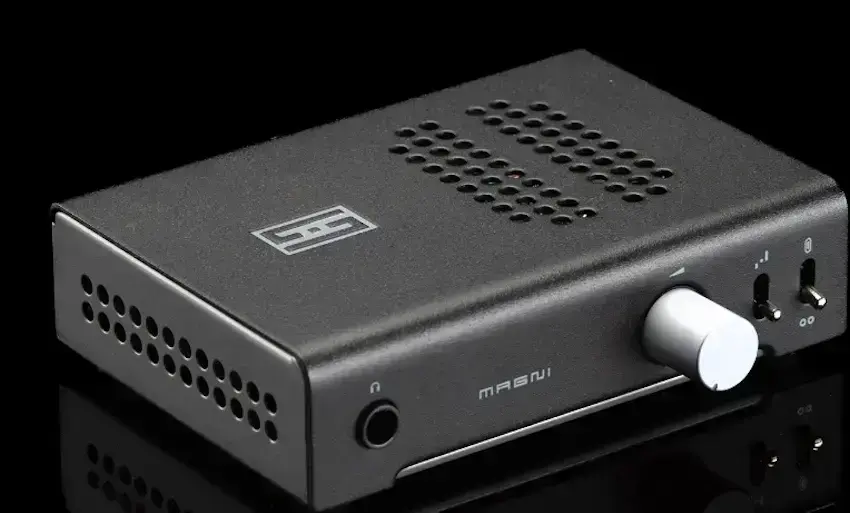
The Magni is one of Schiit’s most popular products since its introduction in 2011. The Magni headphone amp, with its companion Modi DAC, was a combination that offered over 1 watt of power at 32 ohms, and a DAC with a sound DAC chip and quality components around it. Most folks deep in the headphone hobby have owned or still own a Magni/Modi stack as it has crazy performance and power for the money and makes a great low-cost headphone rig for the office, bedroom, or anywhere else you want good, clean power but small size.
Schiit’s philosophies combine measurements and listening to get to a competent design that sounds musical while still having good measurements. Many audiophiles applaud that Schiit puts measured engineering and knowledgeable listening to work on their designs. Ultimately, in the end, Schiit took all they had learned over the years, making all the different versions of Magni, and designed an all-new Magni, reviewed here.
For the Magni Unity (or Magni 5, whichever floats your boat!) Schiit decided to rework the design, allowing both competent measurements and a musical sound.
From Schiit’s Website:
“Magni Unity debuts our new super-linear, high-precision current-feedback discrete topology—an exotic, bespoke amplifier stage unlike anything available from the competition. Coupled with the best parts, from a custom, sorted Alps potentiometer to silicon and film capacitors and 0.5% thin-film resistors, Magni Unity delivers better sound, as confirmed by our blind listening panels.”
This whole new amplifier design offers impressive specs at Output Power. 16 ohms: 3.0W RMS per channel, 32 ohms: 2.5W RMS per channel, 50 ohms: 1.5W RMS per channel, 300 ohms: 415mW RMS per channel, 600 ohms: 220mW RMS per channel. With a distortion spec of: THD+N, Low Gain: Less than 0.0001% (-116dB) at 2V RMS into 300 ohms, High Gain: Less than 0.0003% (-108dB) at 2V RMS into 300 ohms. This means that while the Magni can power almost any headphone out there (not counting Tungsten or other super hard-to-drive planars), the distortion is about the same as competing op-amp-designed amplifiers.
Three settings on the Magni’s front panel control the gain levels from the lowest setting(-10dB) for IEMs and very sensitive headphones, allowing the lowest noise floor possible. To Unity gain for harder-to-drive IEMs and standard headphones. And finally, a +15dB high-gain mode unleashes all the available power for harder-to-drive headphones. In this review,
I drove the HIFIMAN Arya Stealth on Unity gain (normal gain mode) and never had to move it (I could even run them in low gain with a high volume setting). I also tested my Meza Alba IEM on low and unity gain and heard zero noise and a completely black background. I was very impressed with the low noise and the ability to dial in the gain to whatever you are powering. I even had the HIFIMAN Susvara Unveiled here for a short time for some marketing work, and the Magni Unity had no problems powering them as loud as I wanted to go. This proves that for most people, the Magni Unity will be enough for them now and in the future as far as power goes.
Another thing I noticed was that with every change of the gain setting, the sound changed a little. (While the frequency itself does not change with volume, the human ear’s perception of certain frequencies can change with loudness. For example, at louder volumes, the ear may become more sensitive to both the low and high frequencies, making the sound appear more “full” or balanced. (Editor.)
This is expected as all three gain settings use varying levels of current feedback to reach these different gain levels. Feedback rises as the gain setting is set lower, meaning the lowest -10 setting will be higher in feedback. In my tests, I found the unity gain offered the best combination of control and musicality, so I generally stuck with it no matter what headphones or IEMs I used. A good-feeling volume knob, input selector, and ¼” headphone jack keeps the front panel clean and usable.
Many people complain about the wall warts that many of these more affordable products use. But Schiit does things differently. They do use a wall wart. But it is a step-down transformer in a small plug-in box. It provides 16 volts of AC power to internal circuits that finish the power supply.
Remember seeing the super high-priced two-box amplifier at the trade show? They separated the noisy transformer from the delicate circuits for better sound. This is precisely what Schiit is doing here. Removing the noisy transformer from the circuits is the best way to keep the signal clean and noise-free. So in this case, Schiit is doing something innovative versus just trying to be cheap with a DC wall wart. This is also a big reason why the Magni Unity is so small and easy to manage.
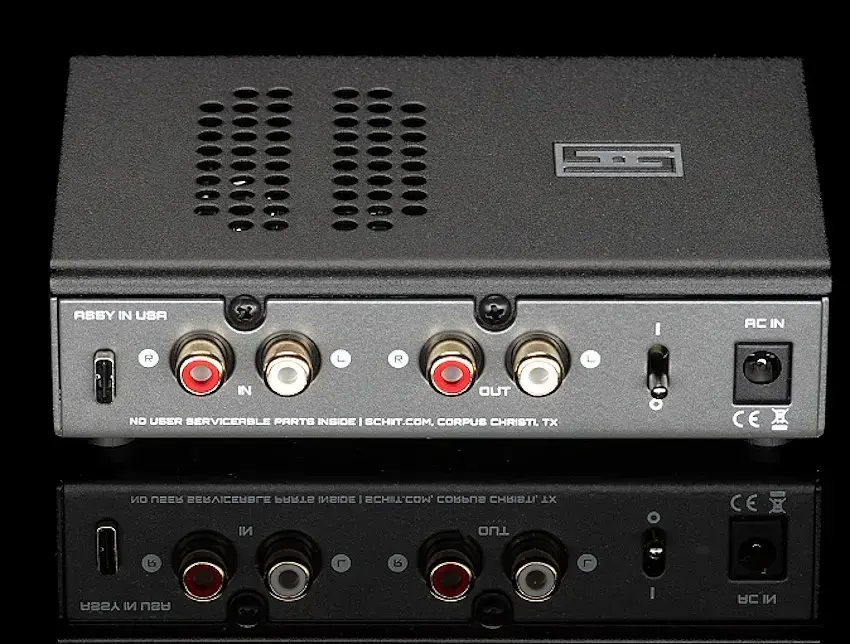
The back panel is equally complete and straightforward, with RCA inputs for outboard DACs or phono preamps, RCA variable outputs for powered speakers, an AC input for the power supply transformer, and the on/off switch( some complaints about the rear-mounted power switch, but it did not bother me in the least) as when I listened I just left the unit on for that time.
One of the best things about this new Magni is the addition of a DAC card that can be purchased preinstalled in the Magni, purchased and installed yourself later(with directions), or scheduled a time when you send the Magni back to Schiit for the card to be installed.This DAC card is limited to USB-C as the only input, but for most computer or phone users, this is the only input they use. If you need more inputs, Schiit has other outboard DACs like the Modi or the new Mimir that offer more inputs. The DAC card has an ESS ES9018 DAC chip, which some will say is older and can’t compete with new chips.
While the latest chips perform better in raw measurements, I have said for years that the DAC chip itself isn’t the whole story. I have heard DACs with top-of-the-line ES9039 PRO chips that sound horrible and brittle, and great-sounding DACs with older chips like the ESS ES9018, AK4493, or AK4490 chips from AKM.
Schiit uses their new Unity USB input in this card, as this implementation is an all-Schiit design and doesn’t rely on chips from XMOS or any other maker. I was delighted with the Unity USB as it easily found either my laptop or phone and never lost signal or had any artifacts that some earlier USB implementations contained. However, there is something of a cheat code for these more affordable DACs.
Most reference-level or higher-end DACs employ galvanic isolation in their USB implementations, and even Schiit’s higher-end DACs employ it. This completely kills any phone or computer noise in the USB signal. Affordable DACs, like the card in the Magni Unity, do not have this galvanic isolation since it would add costs to a component they are trying to keep affordable.
This is one of the reasons that some DAC chips are known for being harsh. If you don’t give the DAC chip a pristine source signal, you risk adding brightness to what would be great sound! I used an IFI IGalvanic 3.0 that I had on hand from my time using a custom computer rig as my music streamer. I know how much this unit can help with USB audio transmission from less-than-perfect devices. And this was the case here.
The IGalvanic 3.0 worked to smooth out the digital nasties that extra noise produced. It took an otherwise good-sounding DAC card in an affordable combo and took it just another step up. This is not needed to get a good sound with the Magni Unity, but depending on your source, USB noise, it can help the DAC sound less fatiguing and natural.
Interestingly, Texas Instruments has developed a more impressive isolation chip that JDS Labs has used to introduce the JDS Synapse. A $69 device that does the same isolation and is much cheaper than the IFI’s original price. If you use a laptop, desktop computer, or phone as your primary source for the Magni Unity, adding this kind of isolation will take the DAC to the next level in fatigue-free sound.
After installing and using the Schiit Magni Unity for a while to ensure it was working at its best, I sat down with the other part of this review rig to see if the match would be as good on my ears as it was on paper! But first:

Hifi Man
HIFIMAN was founded in 2007 by Dr. Fang Bian and was instrumental in the headphone listening explosion in the mid-2000s. Their work developing planar magnetic drivers has allowed them to garner several awards for their headphones. From the HE-5, which was HIFIMAN’s first planar headphone, to the award-winning HE400s and HE-1000, HIFIMAN has always impressed with both their level of engineering and their value. Today, HIFIMAN has headphones at almost every budget level, so anyone interested in excellent music reproduction can find a model for them.
HIFIMAN makes the great Sundara and HE6se. They are excellent headphones and punch well above their price. But in my opinion, the best deal on headphones right now is the Arya Stealth. When it first came out in 2021, it was priced at around $1,600, which is a lot for most people’s headphone needs. For this review, I selected the Arya Stealth because it represents the best price-to-performance of any headphones available right now. At $599, this headphone is a steal!
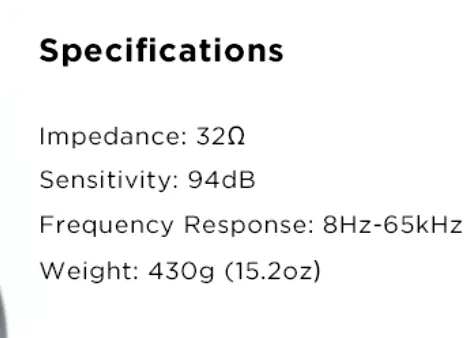
The company themselves have a combo deal with the Stealths and their EF500 DAC/amp here, which is also worth considering. I have not heard of the EF500, but I would assume that, coming from the same company, some synergy will be there. With an Impedance of 32 ohms and 94dB sensitivity, the stealth should be easy to power with any decently powerful desktop or portable headphone amplifier. But if you are a fan of using EQ or putting a bass shelf on your headphones, be aware that you will need more power than usual.
One of the benefits of the Arya Stealth is its nanometer-thick diaphragm. This ultra-light diaphragm has a submicron-thickness conductor layer, allowing the best electromagnetic contact with the magnets. This is why the Arya Stealth is so fast and can reproduce transients better than many headphones on the market. You will get the kind of detail that most headphones in this new price class struggle to produce.
Many might think that HIFIMAN calls this headphone “Stealth” because of its understated and blacked-out appearance, which might be partially true. However, the main reason is the magnets used in its design. HIFIMAN uses what they call Stealth magnet technology. This means that they use specially curved-shaped magnets to allow sound to pass through the magnets without any diffraction, causing changes in the sound waves. This improves frequency response linearity and keeps any forms of distortion to a minimum.

The grills on the Arya Stealth are what HIFIMAN calls the “window shade” grill system. This system protects the drivers from harm while being designed to be as acoustically transparent as possible. The headband is HIFIMANS’ newly enhanced comfort headband, which is supposed to be their best yet.
All of HIFIMANS’ best headphones use this headband; for me, it was pretty comfortable. I could wear the Stealth for quite some time before I tired of them being on my head. The earcups are also unusually large and should be able to fit many ear and head sizes. This is great, as I have reviewed or listened to many headphones lately with tiny cup sizes, which would pinch my ears and cause unwanted ear claustrophobia.
The earpads are also a critical comfort metric that you must look at. The earpads on the Arya Stealth are easily replaceable and quite comfortable for long listening sessions. They are made with a synthetic leather outer ring and a soft cloth surface that touches your head, which was pretty cozy to me.
Schiit Magni Unity and HIFIMAN Arya Stealth Sound Impressions:
When I got both of these pieces, I was immediately impressed with what you get for the money. Both the Schiit and HIFIMAN pieces use simple packaging, which is fine by me and saves costs to the customer. I got both pieces out and inspected them for any issues, and both were in perfect condition.
Powering up the Magni Unity was as easy as plugging in the wall wart and my phone into the USB-C port. Schiits Unity USB was seen by my phone or laptop without issue and proved one of the most stable USB connections I have seen in a product at this price. It just worked every time, all the time! Unlike other products I have witnessed, it also worked with my USB isolator without any compatibility issues. The Arya Stealths come with a ¼” headphone cable, perfectly matching the Magni’s single 1/4” jack.
I connected the Stealths to the Magni and let them play for a couple of weeks of casual listening to let things break in and settle before getting serious. These changed a lot during their break-in and reminded me of some of the Grado headphones I have dealt with in the past that changed drastically over time. So I made sure to let these headphones do their thing before taking them seriously. After that time, I finally sat down for a serious listen.
Listening to All Them Witches’ 2015 album “Dying Surfer Meets His Maker,” I was left with a very detailed and neutral performance. The Magni Unity proves to be mostly neutral with a touch of warmth in the bass and a very slightly rolled-off upper treble, which was delightful. After listening to this album, I decided I needed to EQ the treble down a bit. The strealth’s are almost dead neutral from the bass up through the midrange, with only a dip from around 1 kHz to 2.5 kHz, which seems to be a theme with HIFIMAN headphones.
I am not sure if they do this for tuning reasons, since this area of the frequency band may be offensive to some ears, or if it is the driver. Still, I was able to successfully fill in that missing area and reduce the treble by a couple of dB, and things started to come into focus. The beautiful thing about these capable planar magnetic headphones is that they take EQ like a champ. I was able to lower the treble to my liking, fix the deficiency in the upper midrange, and add a small bass shelf, which was my preference. Then things started showing me how much audio you can get for around $1K in 2025!
The imaging was very detailed, allowing me to hear excellent instrument placement. Also, for soundstage fanatics, this headphone is known for soundstage, and that is exactly what I got, a great soundstage! The $189 Schiit Magni allowed me to hear a huge soundstage that was surprising for its size and price. In my time evaluating this rig, I also spent some time with the very impressive but $10K Audma Meastro HPA-1. I did not have this amplifier in for review, but was doing some marketing work and could not help but see what this reference-level product could do.
Moving on, I played tracks from Organ Freeman’s 2025 album “Busywork.” It features Michael Buckley and is a fun jazz album with a good production. The Schiit/HIFIMAN combo proved rather capable with these tracks. The treble was detailed, the vocals were clean and natural sounding, and the midrange allowed instruments to do what they did without issue. The bass was admirably full and taut, but warm, and sounded much better than the price would suggest.

While dynamics were not on the same level as the Audma, they were impressive for a tiny box! Now, I am not saying that these two amplifiers are directly comparable as the Audma is in an entirely different price and use class. But, I would be remiss if I did not mention how satisfying the Schiit Magni Unity and HIFIMAN Arya Stealth were listening to these tracks. Can you do better? Possibly, but the crew over at Schiit has made a compelling reason to save your money and get a hefty dose of the high-end sound everyone is enamored with at this price level.
Conclusion:
Over the years, I have seen systems costing the better part of a million dollars and have walked away either impressed with what I heard or thinking it was not worth the price tag! I don’t think anyone listening to the Schiit Magni Unity/HIFIMAN Arya Stealth combo would think it is not worth the price. They might decide that for them, this small, easy-to-live-with system is all they need to satisfy their musical listening needs!
I must credit Schiit Audio for designing such a good product for the money. It won’t defy science or power headphones like the Modhouse Tungsten, but that is true of most amplifiers! However, it gives you enough super-low distortion power to easily power 95% of headphones on the planet, with the option for a good internal DAC that, with some help from a cleaner USB signal, proved impressive!. The build quality is good, and the design is attractive and straightforward.
HIFIMAN’s move to put the Arya Stealths on sale at this price is also great and is what allowed me to put together such a rewarding system at this price. So, if you are in the market for an office headphone system, bedroom system, or looking to get into high-end audio, but the prices are making you sweat, investigate this small and mighty headphone system as a less expensive way to get into the hobby. Very highly recommended!

Magni unity’s price
$119 without DAC card
$189 with DAC card
HiFiMan Arya Stealth
$599 on sale
Specifications:
Schiit Magni Unity:
Frequency Response: 20Hz-20Khz, +/-0.01dB
Output Power
Maximum Power, 16 ohms: 3.0W RMS per channel
Maximum Power, 32 ohms: 2.5W RMS per channel
Maximum Power, 50 ohms: 1.5W RMS per channel
Maximum Power, 300 ohms: 415 mW RMS per channel
Maximum Power, 600 ohms: 220mW RMS per channel
THD+N
Low Gain: Less than 0.0001% (-116dB) at 2V RMS into 300 ohms
High Gain: Less than 0.0003% (-108dB) at 2V RMS into 300 ohms
IMD
Low Gain: Less than -110dB at 4V RMS into 300 ohms, CCIF
High Gain: Less than -108dB at 4V RMS into 300 ohms, CCIF
SNR
Low Gain: Greater than 122dB, referenced to 2V RMS
High Gain: Greater than 112dB, referenced to 2V RMS
Topology: Fully discrete, DC coupled, current feedback, highly linear open-loop with low loop feedback
Protection: Failsafe DC power input and muting relay, overcurrent sensing, and output lift, DC servo
Power Supply: 100% linear supply with “Wall wart” style 14- 16VAC transformer, regulated +/-17V rails with over 8,000uF total filter capacitance
Power Consumption: 2W idle, 12W max
Size: 5 x 3.5 x 1.25”
Weight: 2 lb
HIFIMAN Arya Stealth:
THE SOUND ADVOCATE
WHERE the MUSIC BEAT meets the AUDIOPHILE ELITE ! SUBSCRIBE BELOW!
Thank you for subscribing.
Something went wrong.
