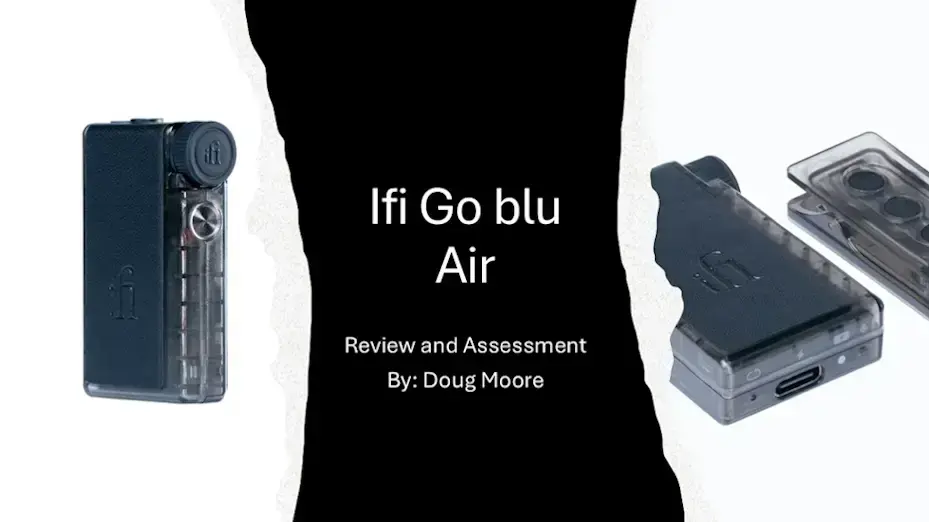
The Ifi GO BLU AIR DAC/AMP make a formidable impression on Douglas Moore!
When I was a young kid with my Sony Walkman and cheap headphones, if you had told me there would be a day when you could go anywhere with high-quality sound, I would have thought you were crazy! Between limited battery life, limited output power, and headphones that frankly sucked, the 80’s were a hard time for portable music lovers. Things for portable audiophiles have improved greatly since then.
While it took many years and multiple stumbles, Bluetooth audio has recently come into its own and is very close to closing the gap with wired sound. With new codecs like LDAC and AptX Lossless, Bluetooth is within earshot of producing true lossless sound. I will admit I was a wireless skeptic for many years, as I knew the quality was not up to my very picky standards, but today is a new day!
Ifi has been at the forefront of quality portable audio since 2012, after the headphone explosion really took hold. The way they design their products is almost as different as the way they sound! Instead of just using measurements to design their products, they also use listening sessions to ensure the product doesn’t lose the musicality that keeps people listening longer.
Ifi devices use mostly discrete or in-house designed output sections and DAC chips from companies like Burr Brown(TI) or Cirrus Logic that buck the ESS or AKM trend everyone else is on. They do this for a reason, and it isn’t the latest Sinad measurement on your favorite measurement website! They do it because, to them, it makes a better-sounding product.

They have a resume of awesome products including but not limited to the excellent HipDAC, xDSD Gryphon, and Idsd Valkerie, a portable powerhouse, and the Go Link series of affordable, good-sounding products.
Ifi has also been on a roll lately with wireless products for IEM and headphone users alike, producing the Go Pod series of wireless IEM DAC/Amps and also the Go Blu series, which is the topic of this review. Ifi sent me this product for review to see if their new creation can get a true music lover to like it.
The Go Blu is a very different device from their other portable audio options. It is designed to do one thing and do it well. If you are a music lover who likes to take your music with you, but knows the hassles that cables and wires can bring to the party, and also knows that most true wireless IEM’s and headphones are feature-over-sound, you might want to pay attention.
The Go Blu is simply a DAC/Amp, but gets its audio from a wireless signal. This adds the ability to take your favorite IEMs, or even open and closed-back headphones, along for the ride without the headache of cables tied to your phone. Keep the phone in your pocket, clip on the Go blu Air with your favorite headphones connected, and youre readye, good to go.
The Go Blu Air is a very small device at 2.11 x 1.33 x 0.77”, which allowed me to fit it in about any pocket or use the included removable clip to clip it to a jacket or pants. The build is plastic but very solid and feels nice and well-built in the hand. The casework is a dark grey translucent that allows you to see the inner workings of the Go blu which is kind of cool as well. Ifi did a good job of keeping the unit light but stout enough for the occasional drop(which did happen to me a couple of times) with no issues.
COSMETICS AND POWER
The Physical layout has a main power button mid-mounted on the left side of the unit, and an actual volume knob (great thinking!) and function button on the right. Having a separate, analog volume knob is a godsend for this device, as it is easy to use and does away with the need for digital volume control from the device or phone (which can degrade the sound).
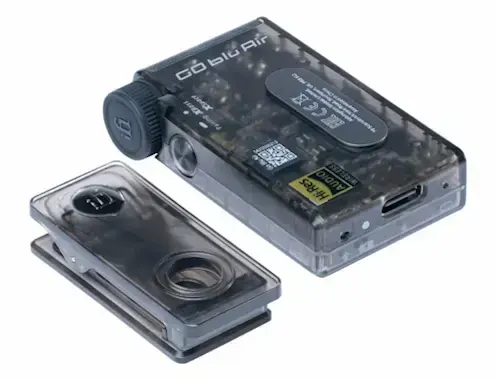
Once I connected the Go Blu to my phone for the first time, it connected automatically without fail and gave me a nice greeting that told me what codec I was using(very helpful to make sure all is good in wireless land). On top of the Go blu is a set of 3.5mm single-ended or 4.4 balanced connections, allowing you to use almost any headphone or IEM on the market.
Power output for these jacks are ≥262mW/2.9V @ 32Ω; ≥52mW/5.6V @ 600Ω from the 4.4 balanced output and ≥165mW/2.3V @ 32Ω;≥14mW/2.9V @ 600Ω from the single ended 3.5mm. This is much more powerful than I had anticipated this small a device to be. Quite honestly, these kinds of power specs were a surprise and allowed me to use my HIFIMAN Arya Stealth with frankly great results.
Although this tiny compact unit won’t power your favorite headphones like a true desktop-class headphone amp, for portable use and on the go, I was easily able to get my desired volume while only losing a small portion of the dynamics and soundstage of my affordable desktop reference. But I mostly blamed Bluetooth's ability to squash dynamics in the compression stage for the dynamic limitation.
The Go Blu Air gets its Bluetooth signal using a Qualcomm QCC5144 chipset, which is Bluetooth 5.2 capable. This allows any Bluetooth-capable device to send AAC (for you locked-in Apple users), LDAC, and aptX adaptive. This also allows any previous older codecs like SBC and aptX to be compatible. While aptX Lossless is not included in the Go Blu Air, aptX Adaptive and LDAC worked without a hitch in my time with this device.
Using a Qualcomm Bluetooth processor was a great move for Ifi since Qualcomm is always at the forefront of Bluetooth technologies. I used this device from my Samsung Galaxy S25 ultra, which has built-in LDAC support as well as the Questyle QCC dongle. This allowed me to also listen with aptX Adaptive, which, for some reason, Samsung does not include with their phone. Both were easy to get going, and with the Ifi Nexis app, I could see what codec I was using. I also tested the Go Blu with my Dell XPS 13 laptop with good results( limited codec support due to Windows Bluetooth limitations).
For DAC duties, the Cirrus Logic CS43131chip is used. This is a popular chip used in portable audio devices for its combination of neutral sound quality and low power consumption. This allows the Go Blu Air’s 450 mAh Lithium Polymer battery to yield up to 10 hours of battery life.
But overall, the battery life was as expected and close enough to spec that I was satisfied. Ifi added a couple of extra features to the Go Blu Air that might excite folks who love their music with a little bit more bass, or space, for that matter. These aren’t just thoughtless add-ons as they are pure analog circuits that allow either the bass to be boosted (mostly for users of dynamic open-back headphones) to boost the lost lower registers of sound, or for the extra soundstage and spaciousness needed for some closed-back headphones or IEMs. Both worked as designed and did not degrade the signal at all, as some digital processors do.
While I use parametric EQ to sort out all my headphones, I did not rely on these for my tests, but did use them in various scenarios to make sure they functioned as designed. And I applaud Ifi for making these settingsonly a function button away, with lights that alert whether the setting is either on or off.

The SOUND!
Now that I am through with all of the product details, I can finally get to the fun part, which is listening! I came into this review with a level of skepticism, as I have tried Bluetooth DAC/Amps in the past that left me feeling unimpressed. But the Go blu Air is different, it is designed togive users a wireless portable option for users on the go, without the downgrade inperformance that many past Bluetooth options gave.

Eric Bibb’s 2026 album “One Mississippi” is a great addition to the world of acoustic blues music. The sound quality is great, and the songwriting is the same. The title track, “One Mississippi,” offered a great bass line that the Go Blu Air tracked very well. Is it on par with my desktop reference or wired portable headphone DAC/Amps? Not quite, but it proved to keep the music going without the bass losing its composure.
The tonal balance of the Go Blu Air is on the warm side of neutral, which I have come to expect from Ifi products. Generally, Ifi puts their efforts on musicality and long listening enjoyment over measurement scores or the last-minute detail. I can count on Ifi products providing a smooth and musical midrange, which the Go Blu does.
The treble is smooth and keeps with the warm trend of the midrange. If you are looking for the last detail or a bright, lively character, you might be better off with something like the Qudelix 5K, which is also a Bluetooth portable DAC/amp with similar power output and features, but features the brighter, more lively ESS DAC chip.The Go Blu Air had plenty of detail; it just delivered it in a warmer, more non-fatiguing fashion. (Sounds good; ed.!)

Dave Douglas’s 2026 album “Four Freedoms” has been on my playlist since it was released, due in no small part to the great recording quality and musicianship. These guys can play, and the recording lets it shine. On tracks like “Grits,” The drums are realistically percussive and impactful. While the Go Blu Air captures most of the detail minus a little bit of Bluetooth loss (mostly in the leading and trailing edges of instruments), the dynamics are where the Go Blu showed its Bluetooth nature.
It does not matter how much money you spend on Bluetooth products; they all seem somewhat dynamically limited compared to their wired competition. This is not the fault of the Go Blu, as all Bluetooth products seem to suffer from this. They just lose the last bit of dynamic realism that makes cymbals come alive, and vocals have the energy that takes you to the performance. Hopefully, at some point when “true” lossless Bluetooth or wireless transmission comes out, this will be a thing of the past, but we still have some work to do. I will say this: if you don’t have your wired reference next to you, it is hard to hear the difference in everyday listening. But when directly compared, it is noticeable.
Soundstaging and imaging on the Go Blu Air are very good for this type of device, and only when compared to my HipDac or desktop references does it fall short. It still has a believable head stage but seems a little narrower and compact in its spread. Also, instrument placement, while good, will not hold up to many wired options. But for a Bluetooth device, the soundstage and imaging are very competitive for the price and style of the device this is.
Conclusion:
I have heard plenty of wired and wireless options out there for us headphone listeners, and some have been impressive while others have not been so much. The Go Blu Air has proven to me that this simple-to-use device lives up to its design. It provides a thoroughly enjoyable and non-fatiguing listen, for when you are on the go and want to take your favorite IEM’s or headphones with you. For the price, it competes or betters anything else out there in both features and sound quality, albeit with a slightly warm and sound if that is what you are after. The Go Blu Air was simple to connect and control, updates are easy with the Ifi app, and I had no issues with the device during my testing.
The manual analog volume control was a very well-thought-out option that makes the device much easier to use on the go, and the onboard controls are easy to use. Overall, I will say the Go Blu Air is a winner! It combines features and sound to satisfy while on the go. It is very nice to see that Bluetooth audio is finally starting to be a more viable option for us who like our music a little more realistic and detailed.
If you are searching for a wireless option that has the features and enough power for most on-the-go headphones, I highly recommend that you take a look at the Ifi Go Blu Air!
Review Equipment Meze Alba IEM, HIFIMAN Arya Stealth headhones.
Ifi HipDAC portable DAC/amp, Schiit Audio Magni Unity, Modi 5 with a JDS Synapse Max galvanic Isolator.
Price – $129.00

Specifications
BATTERY Lithium-polymer 450mAh approx. ~10 hours (depending upon volume and
headphones)
BLUETOOTH CHIPSET Qualcomm QCC5144
BLUETOOTH CODECS LDAC, LHDC/HWA, aptX Adaptive, aptX HD, aptX, AAC,
SBC
DIMENSIONS 53.5 x 33.7 x 19.5mm (2.11 x 1.33 x 0.77”)
DNR ≥110dBA (Both Outputs)
HEADPHONE OUTPUT Balanced: 4.4mm
S-Bal: 3.5mm
INPUT Bluetooth 5.2
LIMITED WARRANTY 12 months
NET WEIGHT 31g (1.09 oz)
OUTPUT IMPEDANCE <1Ω (Both Outputs)
POWER SYSTEM Charging via USB-C, BC V1.2 compliant up to
1000mA charging current and 6.3 volts
RMS OUTPUT POWER 4.4mm Output
≥262mW/2.9V @ 32Ω;
≥52mW/5.6V @ 600Ω
3.5mm Output
≥165mW/2.3V @ 32Ω;
≥14mW/2.9V @ 600Ω
SNR ≥110dBA (Both Outputs)
THD+N Balanced: ≤0.009% @ (600Ω, 2V)
S-Bal: ≤0.03% @ (16Ω, 1.27v)
THE SOUND ADVOCATE
WHERE the MUSIC BEAT meets the AUDIOPHILE ELITE ! SUBSCRIBE BELOW!
Thank you for subscribing.
Something went wrong.