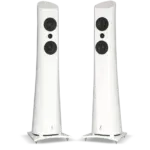
The Dali Epikore 3 Loudspeaker upholds the quality only a great stand-mount bookshelf can offer!
Dali loudspeakers honor their history after 40 years, going from being a private label to becoming a world leader in home theater and hi-fi, manufacturing 250,000 loudspeakers a year. As the artists intended, the brand symbolizes Danish workmanship and a love of music.
Peter Lyngdorf founded Danish Audiophile Loudspeaker Industries, or Dali in 1983. The need for loudspeakers with high quality and natural sound at reasonable costs gave rise to the brand. Since then, Danish engineers started their own inventions in Lyngdorf’s basement. Dali slowly became a high-end specialist after relocating to a new facility in Nørager, between Aarhus and Aalborg, in 1986.
Slowly, but surely, Exports started in 1990 and were first restricted to the Scandinavian market; the first overseas office opened in Germany in 2001. It is interesting to note that 93% of Dali’s manufacturing is sold outside, with exports to more than 70 nations.
Some years back, The Sound Advocate did a full review of the Dali Oberon series 7 loudspeaker, and we were quite totally impressed with their alluring sound quality.
The secret to Dali’s success is innovation: patented technologies like hybrid tweeters, woof-fiber cones, and Soft Magnetic Composite (SMC) magnet systems minimize distortion for as close as you can get to real sound in your listening room. The Kupid, Spektor, Oberon, Opticon mk2, Rubicon, Rubikore, and the expensive Epicon, Epikore, and Kore are notable examples of their current portfolio of loudspeakers.
Under inspection here for this review is the Epikore 3 bookshelf loudspeaker, which, on its own, was a bit of a surprise considering its diminutive size and footprint.
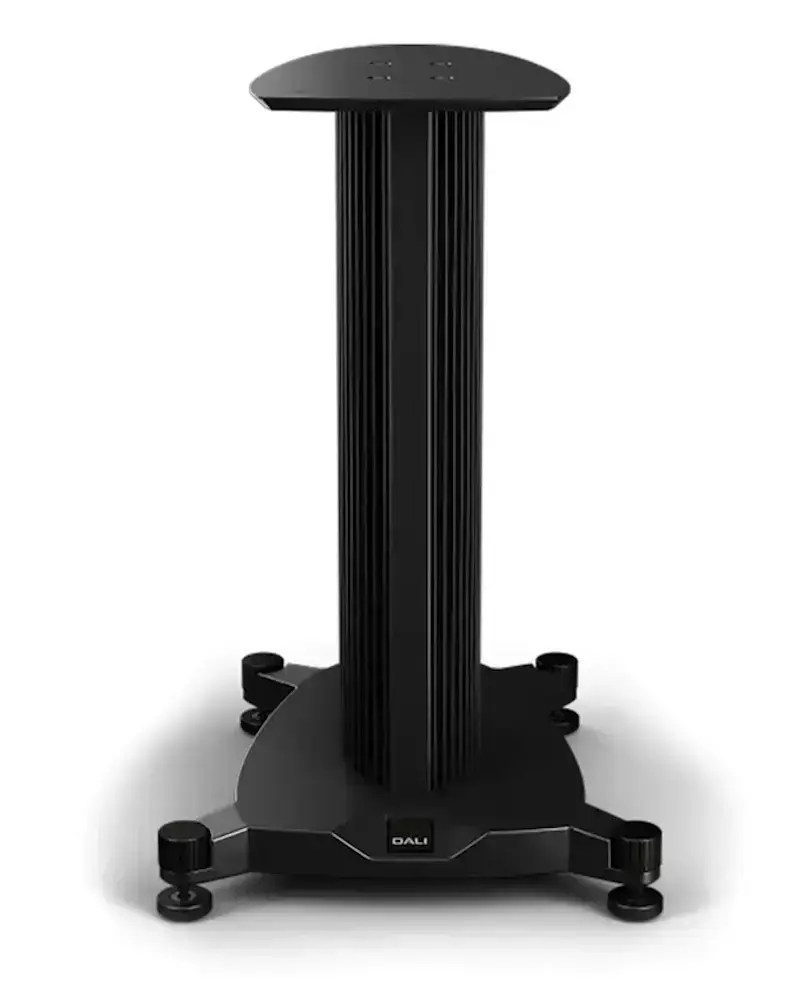
The Epikore 3 is referred to by DALI as a “luxury bookshelf speaker.” Although the terms “luxury” and “speaker” undoubtedly fit, the bookshelf aspect needs to be explained. Each cabinet weighs about 60 pounds, so these speakers are not made for a bookshelf, but with special stands that Dali provides.
The stands are excellently made and of perfect height, with good weight and sturdy stiffness. Being over 17 inches deep, DALI advises having at least 14 inches of space in the back to allow the tapered bass port to function. In my setup, I placed them 3 feet from the back wall and about 3 feet from the side walls in my 25-by-14-foot listening room.
Features & Design
The EVO-K Hybrid Tweeter. This device combines a large planar magnetostatic tweeter with a 35mm soft dome. With minimal harshness or sibilance present, this configuration produces extraordinarily airy, high-frequency extension (up to 34,000 Hz). • A 7-inch Clarity Cone Woofer is used to significantly lower distortion and mechanical loss, while the mid/bass driver makes use of DALI’s exclusive Soft Magnetic Composite (SMC) magnet system.
The Epikore 3 uses its Three-Way design to reach pretty deep into sub-bass frequencies (down to 42 Hz) with ease, providing superb instrument separation and clarity.
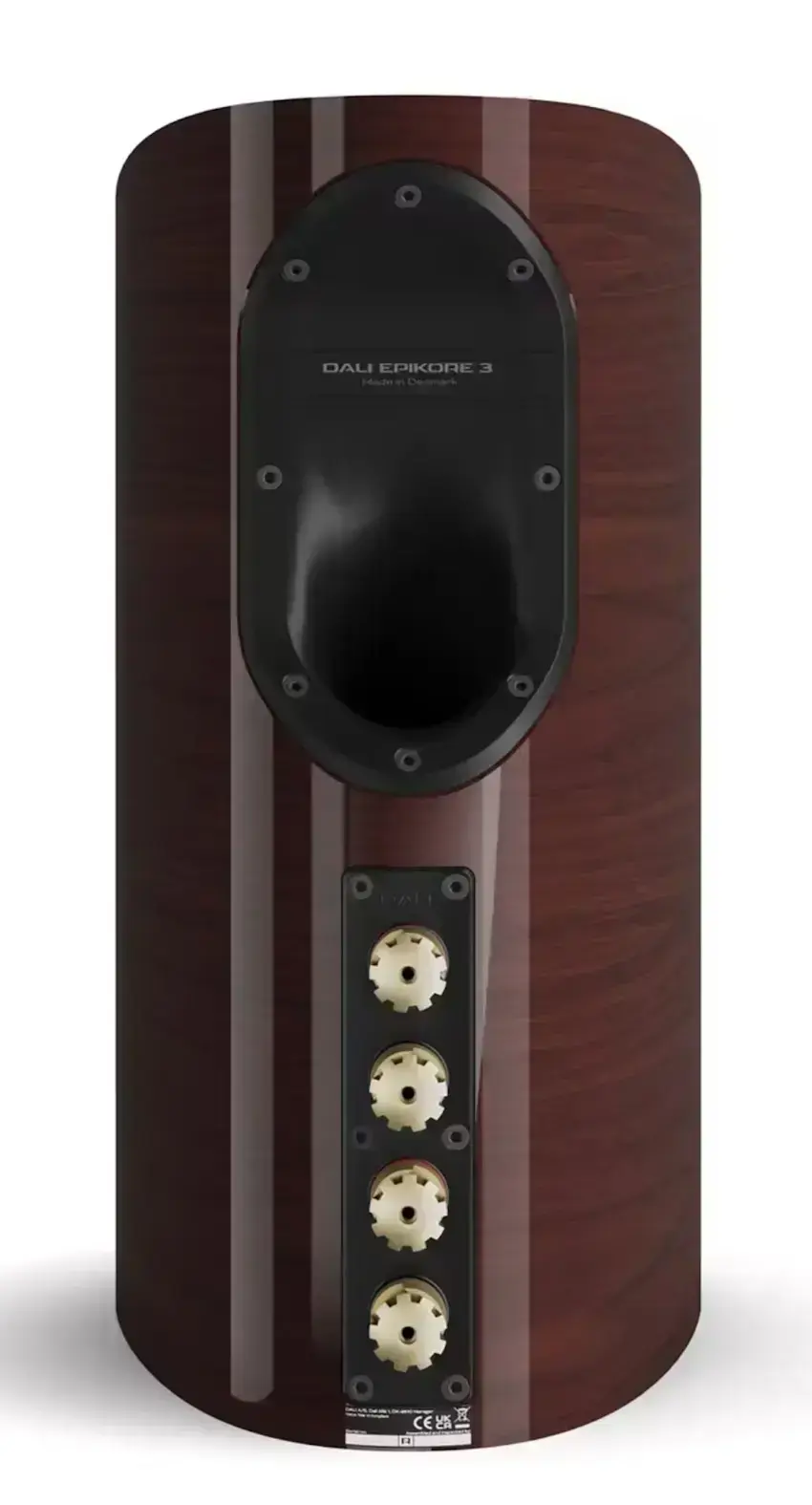
In my experience, its crossover being at 2,800 and 12,500 Hz is distinct. This indicates that the tweeters are accountable for the translucent overtones and the woofer plays a broad range of fundamentals. It can cover more of the upper midrange than a 25mm unit since the soft dome is larger than usual. With coverage up to 34,000Hz, the planar element on top is extremely precise and clear.
Super tweeters like this have a feel component, akin to sub-tones below 20Hz that are sensed but not heard, although this is much beyond human hearing. Speakers with a maximum frequency of 20,000 Hz are unable to generate the air and transparency that a super tweeter can.
The Epikore 3 has a nominal impedance of 6 ohms and a sensitivity rating of a comparatively low 85dB/W/m. We wouldn’t anticipate any electrical compatibility problems because, given the price range, it is reasonable to assume that these speakers will be paired with capable and well-designed amplifiers.
Otherwise, the Epikore 3 features a 35mm soft dome midrange driver working in tandem with a massive planar magnetostatic tweeter. This setup creates some incredibly airy, high-frequency extension (up to 34,000 Hz) without any real harshness or sibilance on male or female vocals.
The 7-inch Clarity Cone Woofer is a mid/bass driver utilizing DALI’s proprietary Soft Magnetic Composite (SMC) magnet system to drastically reduce distortion and mechanical loss.
This Three-Way Architecture seems to deliver excellent instrument separation and clarity, effortlessly reaching deep into sub-bass frequencies (down to 42 Hz). The bass response is real and totally impactful, without the need for a subwoofer for all but the craziest “bass” freaks amongst you!
Listening
A loudspeaker of this quality deserves the best associated equipment to fulfill and evaluate its true and full sound quality and potential,l
Our sources included: Digital: Mojo Audio ‘Mystique’ X DAC ~Musician Pegasus II R2R DAC ~ Innuos Statement server/streamer ~ Audio Note (UK) CD3.1x/2 player/DAC / Analog: Audio Technica LP-7/ZYX Bloom 3 mc cartridge/ Amplification: ~PS Audio PMG Signature Preamplifier ~ Pass Labs XA30.8 power amp/ Argent/Pur Mono-block amplifiers~ Cables/ Conditioners: Inakustik AC-3500p power station &, AC-2404 reference Air Power Cord ~ Audience Front Row speaker cables and Interconnects ~ Clarus “Crimson” 75-ohm digital spdif / Audio Arts 1 e” AC Power Cord.
The positioning of these stand mounts is not very particular. Because of their vast dispersion, it is beneficial to keep them as far away from the side walls as possible. In a typical Dali manner, theoretically, they should be fired straight ahead rather than angled towards the listener for the most tonally balanced results. However, I did (as always) angle them in on their beautiful and sturdy custom stands some 10 degrees towards my listening chair. Thus, the stereo imaging became razor sharp, which I always wanted, while I did notice that the top end got a bit too evident if you wind up angling them in too much in the direction of your listening seat.
Sound Quality Observations
The Epikore 3 bursts onto the soundstage with an immediate presence exhibiting an excellent open and authoritative sound as the music is presented way beyond and behind the enclosures themselves.
As I positioned the speakers at approximately a 5-degree inward angle (as compared to Dali’s straightforward recommendation), the stereo image was immensely sharp and delightfully accurate for the whole sound stage within full orchestral recordings, and the center focus was unimpeachable!
I presented a range of pop, rock, heavy bass, and classical music. Quite personally, I never once considered the possibility of utilizing a subwoofer with these devices. I love both pop and classical music, but unless you play a lot of organ music, the former genre of music benefits less from a subwoofer. Most orchestral, well-recorded classical pieces have undertones that never ask for anything more. This also applied to vocal operatic music.
With pop and rock, I only missed the sub when the music included huge fundamental tones below 40Hz. Otherwise, bass guitar, particularly drums, had a glorious and exalted impact on the overall sound quality. Rock aficionados will never truly want for a subwoofer, in my opinion, and that is a testament to the clean extension provided by the Epikore 3’s capable woofer and its large port.
The Epikore’s midrange is quite exceptional in clarity, intricacy, detail, smoothness, and its wide-open quality for its size. Instruments are wonderfully spread across the opulent soundstage and in exact positions, stereophonically. You can literally touch the orchestral positions with your brain/ears as you watch the front wall where the sound emanates. Many speakers of this quality do much of the same, but the Epikore 3 does it masterfully and in spades.
The midrange sounds rich, roomy, and amazingly close to the original recording thanks to DALI’s exclusive Soft Magnetic Compound (SMC) magnet system, which dramatically lowers mechanical loss and magnetic distortion. That Driver Crossover Integration with its recently created 7-inch driver provides outstanding body and substance while excellently handling instruments and vocals. The EPIKORE 3 guarantees a seamless, gap-free transition into the high frequencies by rolling the driver over to the hybrid tweeter at 2.8 kHz.
Any problems with the Epikore 3?
A few things are otherwise worth noting with this fine-sounding loudspeaker. Feed the DALI a complex, multi-layered mix, and it usually laps it up, with no fuss, no confusion, or congestion. However, some Live recordings of bands or full-scale orchestras, either recorded live or in the studio, can sometimes sound somewhat aggressive in the mid-high frequencies, particularly on massed violins.
The sound is still robust and generous, but even some live classical recordings had a bite to the upper frequencies that sort of made you a bit uncomfortable. On the other hand, many fine and intricate parts of stereo mixes are revealed with well-recorded pop music, and I feel that this is where the Dali is in its forte. Stereo images emerge against an uncluttered background, which suits studio-produced (pop and rock) music very well.
Placing the speakers straight forward into my listening room helped a touch in this respect, but on the whole, this problem came into play more than a few times on some well-recorded material. Corrections did appear, however, when some “audiophile” pop and classical recordings were introduced, so I can honestly say that this was a minor problem with these speakers.
The final Outcome
The highly skilled, high-end standmount loudspeaker from DALI, the Epikore 3, produces an unexpectedly strong, dynamic, full-bodied, generous, and captivating sound. It is a testament to the manufacturer’s skills in this area and has undoubtedly been incredibly well engineered. I had a great time listening to my demo pair. Therefore, it’s a great choice for people who specifically don’t want a floor-standing speaker.
It offers better bass extension than many smaller floorstanders, excellent midrange reproduction, plus the time-honored benefit of big stand mounters with excellent room integration. It can sometimes be slightly aggressive in the upper mid-high frequencies with some program material, but this was far and few between. Therefore, this stand-mount speaker from Dali deserves a firm recommendation!
Dali Epikore 3 standmount with stands $18,000 USD.

CONTACT adam@sohmerassoc.com
DALI Global Headquarters: Dali Allé 1, 9610 Nørager, Denmark. Phone: +45 9672 1155
THE SOUND ADVOCATE
WHERE the MUSIC BEAT meets the AUDIOPHILE ELITE ! SUBSCRIBE BELOW!
Thank you for subscribing.
Something went wrong.