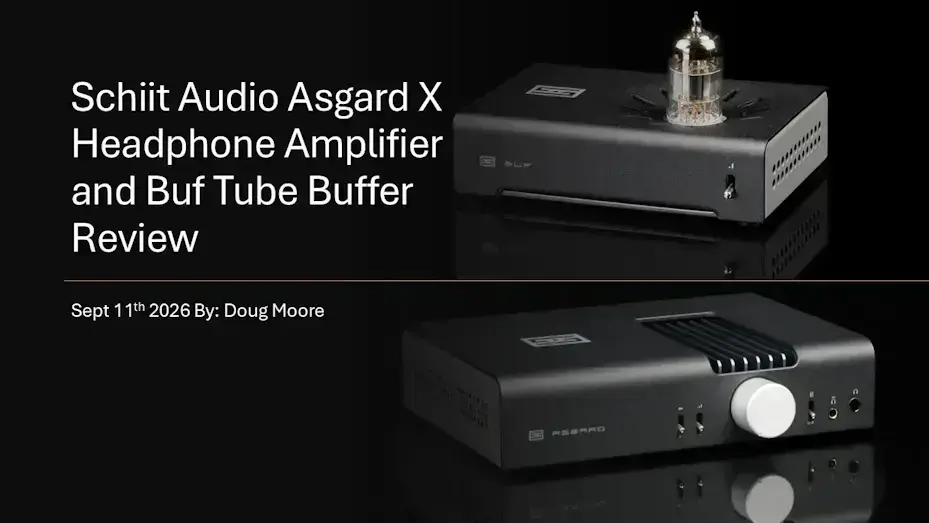
Schitt Audio Asgard X Headphone Amplifier and Buf Tube Buffer is reviewed by Doug Moore.
With headphones becoming a mainstay in the audio hobby, there are a lot of options to choose from. From low-impedance planar magnetics to high-impedance dynamic drivers or even the electromagnetic, when you reach a certain price point, a good front end(amp, DAC,ETC) becomes almost a necessity to get the best from them.
While there are folks out there that will do the math, and based on sensitivity spec alone will say that is not the case, I beg to differ. Music is not a test tone; it is an ever-changing thing that has peaks and dips that can ask much more from a driver, and ultimately the amplifier, than any test tone. And this is why most high-end headphones generally sound better with a good front end!
Headphones have abilities and characteristics that, when done properly, allow you to experience music in a way that is much different, but not at all a downgrade from a high-end speaker system. I like to call headphone listening a different perspective of the music we love. A speaker system gives you the performance in front of you and, if done right, will allow you to hear the recorded space, while headphones allow you to hear the performers and the recorded space like you are in it. Two different perspectives can be equally enjoyable.
When I got back into headphone listening, I decided to do what I did with my two-channel systems: start small and work my way up and enjoy the journey so that when I made it to the upper level of high-end equipment, I could really enjoy what I was hearing. In fact, this review is of a couple of products that I think have moved me up on the path to complete headphone nirvana!
Schiit Audio is a brand that most headphone listeners have either owned or have at least heard about in the audio world, as they make great-quality but affordable home audio and headphone gear. They got their start around 2010 when the headphone movement really started to take hold. They make products at about every price point, and I have reviewed some of their affordable gear here. But this review moves up the line to what many would call the “Goldilocks” area of their lineup.

The Asgard X is a $399 product that is what many call a mini version of the flagship Mjolnir headphone amp. It features what Schiit calls its Continuity™ class A Circuitry. Much of this tech is borrowed from the Mjolnir in a more compact size. This circuit is based on matched JFET and BJT transistors and is not a chip- or op amp-based amplifier. This is also a zero-feedback amplifier, which is refreshing to see at this price point. I know what you are asking- what the hell does Continuity A stand for? Well, it means that both the NPN and PNP transistors are always conducting in the circuit, meaning it is not a push-pull type of circuit, as all devices are conducting at once. This keeps crossover distortion at its minimum, which allows for a smoother overall sound. This is a warm-sounding, warm-running class A circuit with all the smooth characteristics to go with it.
The Asgard X is a powerful amplifier at 3.4 watts per channel at 16 ohms, and 2.8 watts at 32, I will put the rest of the specs below for those who want all the goods, but to say it simply, the Asgard will power all but the most power-hungry headphones on the market to ear-deafening levels. In fact, I can count only a handful or so of headphones on the market that it would struggle with, and the owners of these hard-to-drive headphones know who they are(Tungsten, Older HiFiman ETC). That means that the Asgard X will grow with you as your headphone collection grows.
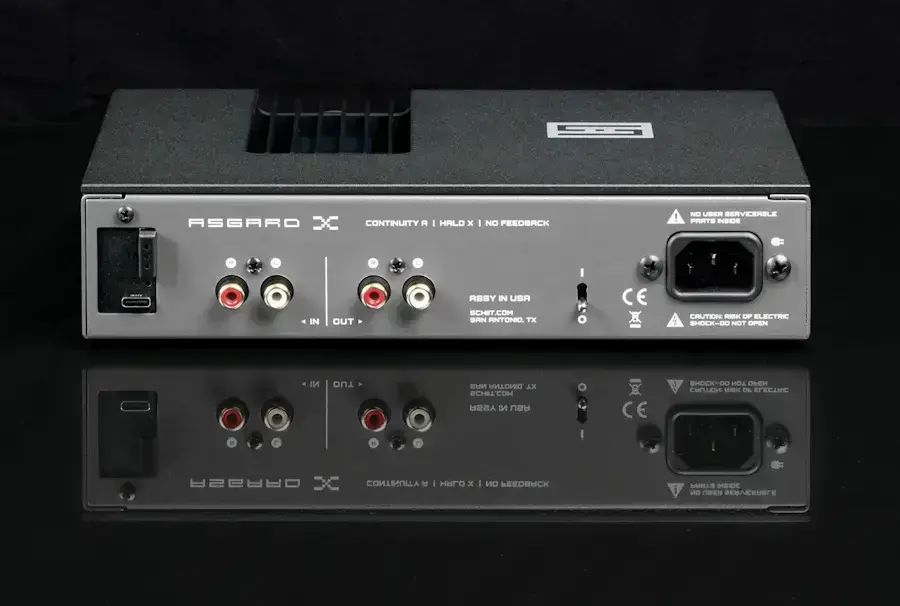
The Asgard X is built for those who like to keep things simple, as it is available in either black or silver finishes and has a control layout that I would describe as Dinosaur simple. There is a power rocker switch on the rear panel, and switches on the front panel for preamp output on/off, gain low/high, input RCA/Internal DAC, and a large, good-feeling volume knob. This is an RCA single-ended-only amplifier, so the rear panel has RCA inputs and a set of RCA outputs for powered monitor speakers or to use the X as a preamp. The Asgard has an internal linear power supply, so there is an IEC connector for power should you ever see fit to upgrade the power cable.
For users who want to transform the Asgard X into an all-in-one DAC/Amp, the X comes with a slot that you can add a dedicated Mesh DAC card from Schiit either at the time of purchase, or later should you choose to do so. My model was not set up with the internal DAC, so I could use an outboard DAC and take advantage of the second part of this review, which I will discuss in a bit.
Hooking up the X was as easy as connecting the power cable, and the RCA outputs from my DAC into the inputs on the back of the X. Simple as can be, and I was up and running.
Connecting your chosen headphones is a matter of choosing the ¼” jack on the front panel or the 4.4mm Halo jack. Since the Asgard X is a single-ended amplifier, it uses a standard ¼” jack for its zero-feedback output and the 4.4 which is not a balanced output but rather an output that adds the Halo Feedback circuit into the mix. This circuit is designed to add a mixed-mode feedback loop into the mix and use the driver directly in this loop. From my understanding, this output works best with dynamic driver headphones, as it is supposed to control the driver better at its resonant frequency. Since planar headphones have a linear impedance unlike dynamic driver headphones, this effect will not be heard with them. I tried the 4.4 output with my HIFIMan Arya Stealth and Grado headphones, and I generally preferred the sound with the standard ¼” output(YMMV).
The Addition!
The second part of this review is a product I was not sure of, but once I tried was addicted too!! The BUF is a new product from Schiit that is very interesting. As the name says, it is a Tube Buffer! I know, I know, they have been around forever, but the BUF is different. It is more akin to a high-end Tube output stage than a normal tube buffer. First, it is powered by an outboard Linear power supply that outputs two separate voltages, 1 for the tube heater and the other for the high- and low-voltage rails. It uses 100 volts on the tube plate, Panasonic film capacitors, and a unique Coherence™ output stage. All this engineering is done to take what many would assume to be an entry-level unit into a very high-performing product.

The BUF uses a single tube in its design. It comes with a NOS 6N1P tube in the box, which is a great addition and allows you to connect right out of the box for tubey goodness, but it also allows for some customization on your part. The BUF will also take 6922, ECC88, and 6DJ8 tubes, so for folks wanting to try their hand at tube rolling, they are set!
The BUF is single-ended and can be added in line between two components to add a tube character to any system. Between a DAC and preamp or headphone amp, a preamp and power amp, or a phono preamp and a preamp. Just connect RCA cables, and the BUF will sit in line between two components to work its magic.
The controls are a simple power switch on the rear panel, and a gain switch on the front. The power switch has a true bypass relay built into the circuit so that when you power off the BUF, the signal is totally bypassed. This is excellent for people who want to switch tubes on or off on the fly! The gain switch is special in that it will boost low signals by 12dB, so if you have a DAC or CD player with a lower-than-normal output level, the BUF can boost it. For most situations, the standard unity gain will be fine. The special thing about the Coherence circuit is that it maintains phase coherence while allowing this extra gain if needed.
The Good Stuff!!
The sound is my favorite part to write about in a review. It’s the meat and potatoes that many people use to help them make purchasing decisions and the part I take the most pride in. For this review, I am especially excited because this combination works especially well.
For starters, the Schiit Asgard X is a very smooth-sounding Class A headphone amp on its own. The sound is fuller-bodied than you normally find in this price class. Notes have weight, and the sound leans towards a warmer quality.

Future Bubblers 2026 album “Future Bubblers 9.0” is a very well-recorded album that allowed me to hear deeply into the Asgard X’s capabilities. The bass had weight as well as detail while not sounding overly done. The midrange had that smooth Class A character that many of us love, and the treble sounded smooth and natural. This amplifier is definitely about the beauty of music and not necessarily the speed. If transient speed is your jam, then Schiit’s own Midgard headphone amp will probably make you happier. But for those who like the soul and natural tonality of Class A will love the X. Imaging and Soundstaging are top-notch for this price class and will take a much higher investment to beat. Overall, the Asgard X by itself was a great-sounding amplifier with this music.
Switching on the BUF between my DAC and the Asgard X took musicality up a notch. With the stock tube, the sound gained additional warmth and soul in the midrange, and a liquidity to the sound that was immensely inviting. It did not change the tonality of the music, but it changed evertthing that stood out in it. Instruments had better separation and, due to the harmonic structure around the root tone, stood out in the mix better. Cymbals carried more harmonic weight and thus became more lifelike. As such, with this album, the Asgard X and the BUF proved to be a complete winner.
Oscar Peterson’s 2026 album “World Tour” is a great collection of Oscar’s tracks from his career and offers another great album to listen to with this gear. The Asgard X on its own sounded full-bodied but controlled. Oscar’s piano sounded dynamic and rich without the shout that lesser amplifiers seem to give pianos. Each note had soul and kept me listening for a long time. There is something about a well-recorded piano that excites me. It’s the hardest to record, but when done properly is amazing. Switching on the BUF with the tube swapped out for a JJ 6922 Gold Pin tube allowed me to dig deeper into Oscar’s piano sound.

The Dynamics were there but different. Instead of the peaks being more apparent, the whole instrument seemed to stand out more. I enjoyed both the solid state only and the Buffed version of these tracks, which is the best part about this combination; you have the choice! In the end, I really couldn’t decide which I liked better, the faster transient speed of the solid state or the liquid richness of the Buffed Asgard X, but it kept me coming back for more!

King Buffalo’s 2018 album “Longing To Be The Mountain” is a great album and one I listen to all the time. It’s recorded well for this type of music, and the guitar effects can show how well the soundstage performs. This album has a wrap-around effect on headphones that is enticing as well as fun. While the Asgard X on its own was really good on this album, it was the BUFFED Asgard X I fell in love with.
With the Schiit BUF and JJ 6922 Gold pin tube in play, the sound took on a whole different character. The soundstage opens up and gives the heavily processed guitars a new dimension. There are just some things that tubes do better, and this album is one of them. With the BUF adding its 2nd-order harmonics to the mix, everything had more body, distorted guitars had a more ethereal sound to them, and drums, especially cymbals, had much more density. The combination of the Asgard X, the BUF, and my trusty PEQed Arya Stealth headphones made a great combination that I believe anyone would find enjoyable.
Conclusion
The Schiit Audio Asgard X is a great headphone amp. No, it won’t unseat a Pass Labs HPA-1c headphone amp, but for its price I can’t think of a more enjoyable amplifier. If you are chasing specs, or want the most neutral amp out there for the money, Schiit Audio makes other products for you. But if you are more into this hobby for enjoyment and getting to the soul of the music, the X is hard to beat at its price. Adding the BUF to the mix takes things into the tubey goodness arena. It takes what is already a great sound and adds just a touch of 2nd harmonic structure to it. It won’t change the tonality of the X, but it will give it more dimensionality to its sound, and it doesn’t hurt that it only adds another $99 to the price of the X. I wholeheartedly recommend any music lover who is looking for an amp package at this price look at the X and BUF combo. It’s a true hybrid approach that gives you the most for the asking price!
Review System: Streamer: PS Audio Airlens DAC: Schiit Modi 5 Headphone Amp: Schiit Asgard X with BUF Tube buffer Headphones: HiFiMan Arya Stealth with PEQ
Asgard X $399
BUF $99
Asgard X Specs:
SPECS
Frequency Response: 20Hz-20Khz, +/-0.015dB
Output Power
Maximum Power, 16 ohms: 3.4W RMS per channel
Maximum Power, 32 ohms: 2.8W RMS per channel
Maximum Power, 50 ohms: 1.9W RMS per channel
Maximum Power, 300 ohms: 380mW RMS per channel
Maximum Power, 600 ohms: 200mW RMS per channel
THD+N
Low Gain: Less than 0.002% at 1V RMS into 300 ohms
High Gain: Less than 0.015% at 1V RMS into 32 ohms
IMD
Low Gain: Less than -90dB at 1V RMS into 300 ohms, CCIF
High Gain: Less than -80dB at 1V RMS into 300 ohms, CCIF
SNR
Low Gain: Greater than 110dB, referenced to 2V RMS
High Gain: Greater than 108dB, referenced to 2V RMS
Crosstalk
Less than -80dB, 20 Hz-20 kHz, 300 ohm load
Output Impedance
SE ¼” TRS output: 0.7 ohms
4.4mm output: 3.5 ohms
Preamp output: 75 ohms
Input Impedance: 50 kΩ
Gain: 1 or 4.5x
Topology: Fully discrete, single gain stage, DC in and DC out, no feedback in either gain setting, Continuity A™ balanced NPN/PNP Class A biased output, Halo X™ on 4.4mm output
Protection: Failsafe DC power input and muting relay, overcurrent sensing and output lift, DC servo
Power Supply: 100% linear supply with 48VA internal transformer, +60V discrete regulated rail, +/-20V discrete regulated rails, and +/-15V regulated rails, and over 25,000uF total filter capacitance
Power Consumption: 14W idle, 22W max
Size: 9” x 6” x 2”
Weight: 7 lb
BUF Specs:
Low Gain (0dB)
Frequency Response: 20Hz-20Khz, +/-1dB
THD: <0.5%, 20Hz-20KHz, at 1V RMS
IMD: <0. 6%, CCIR
SNR: >106db, A-weighted, referenced to 1V RMS
Crosstalk: -90dB, 20Hz-20KHz
High Gain (12dB)
Frequency Response: 20Hz-20Khz, +/-1dB
THD: <0.2%, 20Hz-20KHz, at 1V RMS
IMD: <0.4%, CCIR
SNR: >97db, A-weighted, referenced to 1V RMS
Crosstalk: -80dB, 20Hz-20KHz
Output Impedance: 75 ohms
Input Impedance: 470 kΩ
Maximum output: 8.2V RMS
Topology: Coherence™: tube voltage gain with convolved BJT inverter, run in Class A
Protection: delayed start and fast shut-down with muting relay
Power Supply: wall wart with 24VAC and 6VAC outputs, linear regulated HV and LV rails for tube and bipolar components, 6V AC heater
Power Consumption: 6W
Size: 5 x 3.5 x 2.75”
Weight: 1 lb
THE SOUND ADVOCATE
WHERE the MUSIC BEAT meets the AUDIOPHILE ELITE ! SUBSCRIBE BELOW!
Thank you for subscribing.
Something went wrong.