THE PMG SIGNATURE PREAMPLIFIER by PS.Audio is examined by Howard Milstein
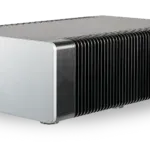
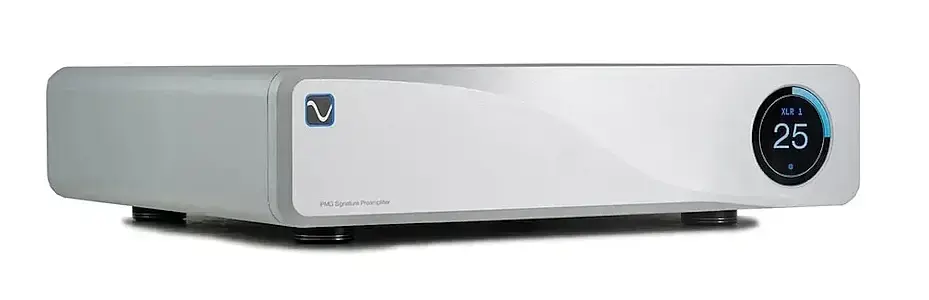
The ultra-high-end, flagship active line stage from PS Audio is the PMG Signature Preamplifier ($8,999). It was designed by Darren Myers to replace the previous hybrid BHK Signature preamplifier and continuing on with their excellent innovative designs, his statement piece bears Paul McGowan’s name in honor of the company’s 50th anniversary. It is designed with an extremely low noise floor and an organically clean, neutral, and non-clinical presentation as top priorities.
The Paul McGowan Signature Preamplifier could be a declaration of what the company can do when all limitations are removed. This is the result of a lifetime of innovation, designed by Darren Myers and bearing PS Audio’s founder’s name for the first time in fifty years.
Every phase has zero-feedback Diamond buffers for unparalleled speed, transparency, and control, and it is fully balanced from input to output. Micro dynamics are shown with lifelike precision thanks to a high-resolution stepped attenuator that guarantees exact volume with 1/10th dB channel accuracy.
Its core is a new power supply that replaces conventional electrolytic capacitors with long-lasting, sonically superior film capacitors. Increased dynamic swing, deeper quiet, and lightning-fast transient reaction are the outcomes. The PMG Signature reaches a noise floor of -145dB—so quiet it’s invisible—and is housed in a solid architectural chasis that protects against interference and noise.
Nothing has been added or removed; presumably,what you will hear is precisely what was captured. No veil, no grain, and no glare. Just the music, alive and without any coloration.
TECHNICAL BACKGROUND

Zero-Feedback Diamond Buffers: Pure Class A, fast Diamond buffers are employed in the fully balanced input-to-output signal route. By eliminating global feedback, this design produces a wide soundstage, realistic dynamics, and excellent transient control without creating treble harshness or excessive sibilance.
Innovative Film-Cap Power Supply: The PMG Signature fully substitutes large, long-lasting film capacitors for traditional electrolytic smoothing capacitors in its active power supply, defying accepted audiophile standards. By making this decision, noise is greatly reduced, and micro-dynamic clarity was found to be substantially increased.
No Capacitors in the Audio Path: This preamp operates as a servo-controlled, direct-coupled line stage with a virtually transparent audio path. If DC blocking (which I tested and found the sound tiny and without life or body) is necessary for downstream amplification, users can choose to activate a software-controlled output capacitor for system synergy.
A Precision Volume Control: Regardless of the volume level, dependable impedance matching is maintained via a high-resolution stepped attenuator with 0.1dB channel accuracy. To be honest, I didn’t really like this setup at all, and I would have preferred an incremental volume control knob instead of it being physically controlled by touchscreen only – meaning no buttons on the front faceplate. That way I could turn and do anything I wanted with my hand while still having complete control over the excellent, reliable remote control. This includes, naturally, all the settings and subsettings on the front of the unit, which are all touch and hit (or miss!!)
The lighted remote control with an aluminum overlay is used to operate the system. Not unusually, the PMG Signature lacks any inbuilt phono stage, DAC, or streaming module and is only an analog line-stage preamplifier. However, most aficionados would be fine with this as they have their separate DAC’s and phono stages on hand.
As for the remote, I will admit, quite honestly, that the remote is very complex and there are too many options, adjustments, and buttons that most users will not need to use on this remote. I like things plain and simple, and this remote is far from that. But of course, some users will admire the intricacy and versatility of the Signature remote.
The front panel is dramatically streamlined, moving entirely to a simple 3-inch glass touchscreen display with a circular swipe motion control for inputs, and volume eschews traditional knobs entirely. Although this is how Darren Myers envisioned this item in his design plan, I myself would have liked to have a straightforward circular control at my fingertips. What can I say, people? It’s up to each individual.
Design
The Paul McGowan Signature Preamplifier is a daring improvement over the previous model. An unprecedented degree of clarity and control is offered by its fully balanced circuitry. This produces a level of sonic darkness that nearly no other preamps with this type of dynamic range that approaches at least 150 dB—so far, have been able to accomplish! The unit’s bandwidth extends above 500kHz for infinite transparency and realism, and its transients burst with lightning speed.
The PMG foundation contains a novel power supply that substitutes conventional electrolytic capacitors with long-lasting, acoustically superior film capacitors. Greater dynamic swing, deeper quiet, and exceedingly-fast transient reaction are the obvious outcomes, as we will explore later on. The PMG Signature can reach a tremendously low noise floor of and completely shields against any interference and noise.

THE SOUND AND LISTENING
The first digital session started quite innocently enough. I have been totally captivated by my FINK TEAM KIM (review coming) loudspeakers and with the Pass Labs XA 30.8 in play, a wonderful huge, and unveiling sound quality started emanating to my listening chair. I was 12 feet from the speakers in my treated room, and the Kims were slightly towed in towards my chair. The PMG was a great match for the Pass Labs (also included were the Musician Pegasus R2R DAC in the mix).
Pairing the PS Audio PMG Signature Line Preamplifier with the Pass Labs XA30.8 stereo amplifier resulted in an exceptionally synergistic, ultra-high-end superb musical match. The combination links a direct-coupled, zero-feedback active line stage with a high-bias, single-ended character Class A power amplifier. They mirror each other perfectly across input/output impedances and signal topologies to maintain complete signal integrity.
Here is a small portion of the sources I used for this evaluation, most if not all of the highest definition and sound quality:
Vladimir Ashkenazy Beethoven Emperor Solti Chicago Symphony Orchestra Ashkenazy Beethoven Emperor
Martha Argerich, Claudio Abbado, live Mozart 20 and 25 live piano concertos- Clifford Curzon conducting
Cantata «Lucrezia» & Operatic Arias: Janet Baker mezzo – Raymond Leppard Their recorded legacy includes deep explorations of the highly dramatic cantata Lucrezia alongside famous standalone arias like “Ombra mai fù” from Serse and pieces from Atalanta.
Cincinnati Pops Orchestra-Eric Kunzel, Fantasy Film Overtures
Frank Sinatra “Ring-A-Ding Ding” REPRISE REMASTERED
I gave the PMG an hour to warm up. As expected, it started to blossom at about ten hours, and by twenty, it was spectacular. The soundstage extended to a large size beyond speaker boundaries (particularly with the FINK KIM SPEAKERS) and displayed details in a very casual way with high levels of clarity. It was crystal clear, a little clinical, yet incredibly melodic. With precise imaging, the PMG eliminated all slight haze and distortions from the music, improving the soundstage and visuals with accuracy and realism!
The sound was dependably cleaand pure, and the instruments and singers (Janet Baker’s album above) had a lovely sense of intimacy and presence throughout every song. The bass presentation was also at an unparalleled level, full-bodied, tight, and incredibly transparent. The sound was smooth and silky with a beautiful treble response which formally integrated into the complete balance; This was a pleasure to behold!
I enjoyed the sound and imagery a bit more with the Pass XA 30.8 over my newly received bridged Quad 303 (review coming) amplifiers as violins on classical music were a touch “smoother,” and this was very important to me. Those massed strings on classical orchestral music were a great virtue on the PMG preamp.
Almost all orchestral recordings or vocals with massed violins had a tempting “clarity” and kept the depth and openness from the speakers solidly back in the sound field. The PMG did wonders on vocal operatic music, taking the voice (Janet Baker) straight and center with a slightly “clinical” texture yet rich with exquisite depth and musicality. I was truly impressed in this case! Low Noise and a “solid black background” were always evident in this recording, and silky “warmth” emanated from the mezzo-soprano’s voice. Stereo imaging was impeccable (with the help of the speakers used, of course, and the sound of Ms. Baker’s voice was enveloped in a magical “singing” nature! Yes, the PMG sparkles with well-recorded vocal music, particularly in this case!
Frank Sinatra’s first ‘Reprise’ recording, Ring-A-Ding-Ding, is not only masterfully recorded but wonderfully textured, and it was presented excellently with the PMG. There was not a trace of ‘sibilance,’ and he sounded as if he was at the Reprise studio mic in front of you but NEVER PUSHED forward! This was a total treat and the combination of the PMG and the Pass Labs was a work of art. Truly delicious indeed!
Eric Kunzel’s “Fantasy Overtures” is a terrificly miked recording, and the PMG went to great lengths again to bring the sound to its most open and deeply lit significance. Cymbals were strikingly beautiful with no hardness or scratchiness, and the huge soundstage was projected with the utmost authority.
Moving to the greatest of female pianists, Martha Argerich, in her live recording of Beethoven, we have a purist’s live recording, and the sound quality revels in soundstage purity, orchestral violin sincerity, and, of course, her piano, centered a “cinch” to the left of center, with a masterful tonality in her live Mozart piano concertos with Claudio Abbado conducting.
Live musical recordings, if the engineer has the right sense of simple microphone placement, bring the PMG (as well as the whole system; most formidably the loudspeakers) into their most engaging form of sound and musical reproduction in your listening room. Another excellent showing for the PMG preamplifier to its utmost.
ANY PITFALLS?
As mentioned above, there are no buttons on the front faceplate of the PS Audio PMG Signature preamplifier; rather, it is solely operated by touchscreen. To be clear, I am generally less enthralled with touchscreens. I much rather turn knobs and press buttons.
Having said that, this device’s touchscreen is very good. I wasn’t familiar with a touchscreen as user-friendly as this one. Perfectly tracking finger motions, the volume control ring is sophisticated. If you wish to alter the input, just touch the current input to bring up a menu with all the other inputs; select the desired one. Every sub-menu functions in the same manner. It’s slick and extremely successful.
I noticed occasionally that the PMG ‘s midrange exhibited a “spec” of glare on certain recordings. This was so minor that it was only noticed when inserting the passive Allegri Reference preamp. (To be reviewed soon!)
However, one must ardently admit that the PMG with certain live recording equalled or bettered the Allegri in its bass authority and super silky high frequency response. Other than this, the unit by Paul McGowan and Darren Myers is quite a masterful preamplifier and especially at its PRICE POINT! (No, it is not cheap, but I have not heard many preamps in this price range that can outdo this unit!)
CONCLUSIONS
Paul McGowan and Darren Myers have given us a preamp that will be remembered and glorified for all its assets! Its outstanding bass delivery is one of its unique characteristics. With its visceral, “tactile presence,” it manages complex low-end information, giving connected amplifiers and loudspeakers a much stronger and more powerful feel.
This unit is “Sweet” but neutral! The PMG preamp offers a flat overall frequency response and a remarkably low noise floor. Without ever veering into a frigid, clinical, or tiring solid-state sound, it is able to transmit a highly resolving, grain-free, and clear signal, while capturing a compelling “sweetness” and natural fluidity without imitating a tube amplifier.
Thankfully, it is able to reproduce (with the right loudspeakers) a massive Soundstage and precise stereo imaging, while offering front-to-back, broad depth resolution. This Preamp provides excellent instrument differentiation, as well as providing discrete spaces for each orchestral player against an extremely “black background.”
As such, the PMG signature preamplifier deserves an “outstanding” recommendation and should be auditioned by every audiophile and music lover who is looking for a long-living preamplifier in this price range… Highly recommended!!
PMG Signature Preamplifier ($8,999)

REFERENCE SYSTEM USED:
Digital: Mojo Audio ‘Mystique’ X DAC ~Musician Pegasus II R2R DAC ~ Innuos Statement server/streamer ~ Audio Note (UK) CD3.1x/2 player/DAC / Analog: Audio Technica LP-7/ Sumiko Blue Point No. 3 Moving Coil Cartridge / Amplification: ~PS Audio PMG Signature Preamplifier ~ Allegri reference passive preamplifier ~ Pass Labs XA30.8 power amp Quad 303 bridged amplifiers/ Argent/Pur Mono-block amplifiers~ Cables/ Conditioners: Inakustik AC-3500p power station &, AC-2404 reference Air Power Cord ~ Loudspeakers ~ Fink Team “KIM” loudspeakers/ Spendor Classic 3.1 speakers ~ Audience Front Row speaker cables and Interconnects ~ Clarus “Crimson” 75-ohm digital spdif / Audio Arts 1 e” AC Power Cord
PS. Audio
THE SOUND ADVOCATE
WHERE the MUSIC BEAT meets the AUDIOPHILE ELITE ! SUBSCRIBE BELOW!
Thank you for subscribing.
Something went wrong.